Tame Impala — The Slow Rush on Vinyl: Every Colour Variant Compared
Eight pressings from $21 to $122. The green limited edition is cheaper than the standard, and only one variant has more people wanting it than owning it.
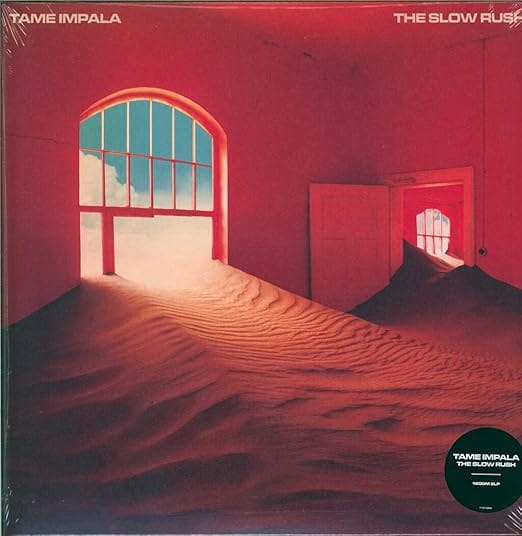
The Slow Rush is a good test case for how modern vinyl variants actually behave, because Kevin Parker’s label pressed a lot of them: forest green, cream, red-and-blue, a splatter edition, territory-specific runs, and a 2022 reissue bundled with a remixes 12”. Six years on, the marketplace has had time to decide which of those were genuinely scarce and which were just a different colour of plastic.
The answer is bracing if you bought variants as an investment.
| Pressing | Lowest listed | Copies for sale | Own / Want |
|---|---|---|---|
| 2020 forest green 2LP, limited cheapest | $21.00 | 48 | 9,061 / 2,0780.23× |
| 2020 Australian 2LP | $28.06 | 2 | 4,191 / 3430.08× |
| 2020 red + blue 2LP, limited | $35.00 | 31 | 8,478 / 3,9370.46× |
| 2020 worldwide standard 2LP | $37.53 | 126 | 17,768 / 4,8980.28× |
| 2020 cream 2LP, limited | $51.38 | 18 | 2,174 / 1,2110.56× |
| 2020 red + blue with gold splatter, limited | $78.81 | 21 | 4,620 / 2,5520.55× |
| 2022 red translucent 2LP + remixes 12" | $103.21 | 35 | 2,407 / 1,5620.65× |
| 2020 UK red + blue 2LP, limited | $121.67 | 7 | 696 / 1,2681.82× |
Lowest listed price is the cheapest copy on the Discogs marketplace at the time shown, before shipping, and across all sleeve and media conditions — treat it as a floor, not a going rate. “Own / Want” is how many collectors have the pressing in their collection versus how many have it on their wantlist; a ratio above 1 means demand outruns supply.
The counterintuitive top of the table
The cheapest copy of this album is a limited edition. The forest green 2LP starts at $21 while the plain black standard pressing starts at $37.53 — and the green one has 9,061 owners against 2,078 wants, a ratio of 0.23. Four and a half owners for every person still looking. “Limited” described the manufacturing run, not the demand, and demand is the only half of that equation that sets a price.
The Australian pressing tells the same story from the other direction: only two copies listed worldwide, which looks like scarcity until you see 4,191 owners against 343 wants. A ratio of 0.08 is the weakest on the table. Thin listings plus no wantlist pressure isn’t a hot record — it’s a record nobody is looking for, in a territory where everyone who wanted one already has one.
The one that’s actually scarce
The UK red-and-blue limited edition is the only pressing here where wants exceed owners: 1,268 people want it against 696 who have it, a ratio of 1.82, with seven copies listed. That’s what real scarcity looks like in this data, and it’s why that pressing costs $121.67 while a visually similar red-and-blue edition sells for $35.
Note that those two are different releases. If you’re shopping for “the red and blue one,” you can pay $35 or $122 depending on which entry you’re actually buying from, and the listing photo may not make the difference obvious. Check the release page’s country and catalogue number before you commit.
Where the middle sits
Everything between $35 and $103 — the standard black, the cream, the gold splatter, the 2022 red translucent with the remixes 12” — clusters in want ratios between 0.28 and 0.65. None of them is scarce. They’re priced by how elaborate the package is, which is a perfectly reasonable thing to pay for as long as you know that’s what you’re paying for.
The 2022 reissue is arguably the most interesting of them, because the extra 12” of remixes is actual additional music rather than additional colour. At $103 that’s a lot per remix, but it’s at least a different record.
What to buy
To listen: the forest green limited at $21, which is the cheapest copy of this album on the market and no worse than any other. Failing that, whichever of the standard or red-and-blue editions is cheapest in the condition you want.
To collect: the UK red-and-blue, understanding that you’re paying a genuine scarcity premium — the only one on this list that the numbers support.
To speculate: nothing here. Six years of data show one variant in eight developing real demand, and it wasn’t predictable from the announcement.
For the wider question of when a limited pressing is worth chasing, our Clipse breakdown runs the same analysis on a release that shipped six variants in a single year.
Prices refresh when we re-run our Discogs snapshot; the date on the table is the date they were true.
Enjoyed this?
Get new reviews and genre guides as they drop.